Do You Have to Learn a Language Every Day?
"Streak: 214 days." This number lights up first thing in the morning on many language apps, before the first cup of coffee. And then, on an entirely ordinary Tuesday, it breaks: a bout of flu, a move, three days without internet on vacation. The streak is gone. For many, this feels like a real loss, sometimes even like a reason to quit altogether. Yet the truly important question rarely gets asked: What did I actually learn in those 214 days? The number of days and the amount of knowledge are two different things, even though many apps like to blur that line.
I want to draw a simple but important distinction here. Consistency helps with language learning, no question. But a broken streak doesn't mean your progress so far is worthless or that you have to start from zero again. This isn't an excuse for doing nothing, it's a sober observation about how memory and language proficiency actually work.
Why Daily Streaks Create More Pressure Than Joy
Streak counters are a clever piece of design. They use a simple psychological mechanism: people fear losing something they've built up more than they enjoy gaining something new. A fifty day streak feels like ownership, and nobody likes giving up ownership. That's exactly what makes these counters effective at bringing people back to an app every day, and exactly what makes them a poor measure of real learning.
The problem shows up as soon as life gets in the way: a child gets sick, a project at work spirals out of control, someone spends a week in the countryside without a signal. Anyone who misses a lesson on a day like that often gets a reminder email with a slightly reproachful tone, and the streak is gone anyway. The result is rarely "I'll just pick up again tomorrow" but often "It doesn't matter anymore." A tool meant to build motivation turns into a reason to quit altogether. This hits the people who take it seriously hardest: anyone who has kept a streak going with discipline for months loses not just a number to a single exception, but often the motivation too.
What Progress Really Means
Someone learning Spanish who can ask a waiter in Seville for the check after three months has achieved something real, whether or not there were two weeks of pause in between. Progress in a language shows up in vocabulary that sticks, in sentence structures that come automatically, in a feel for when "für" fits and when "seit" does. It doesn't show up in an unbroken chain of calendar days, but often first in the fact that simple sentences come reliably.
This distinction is more than splitting hairs. When progress is measured in days, every break punishes the learner twice: once through the actual interruption and once through the feeling of having failed. When progress is measured instead by what someone can actually do, a break stays what it is: a break. Vocabulary you've learned doesn't disappear because you weren't quizzed on it for nine days. It might need a little refreshing, but it isn't gone.
Reviewing Is Just as Valuable as Learning Something New
A common misconception is that only new material counts as progress and that reviewing old lessons is somehow standing still. The opposite is true. The brain forgets according to a well known pattern, the so called forgetting curve: without review, freshly learned vocabulary is half gone again within a few days. Going back over Italian "-are" verbs three weeks after first learning them cements them more firmly in long term memory than ten more new vocabulary words could that same day.
A good learning week therefore rarely consists only of new material. Sometimes the most valuable learning day is the one where you read old sentences again and realize: this has really sunk in. That's just as much a part of progress as seeing a new word for the first time, even if it feels less like it because nothing new is being added.
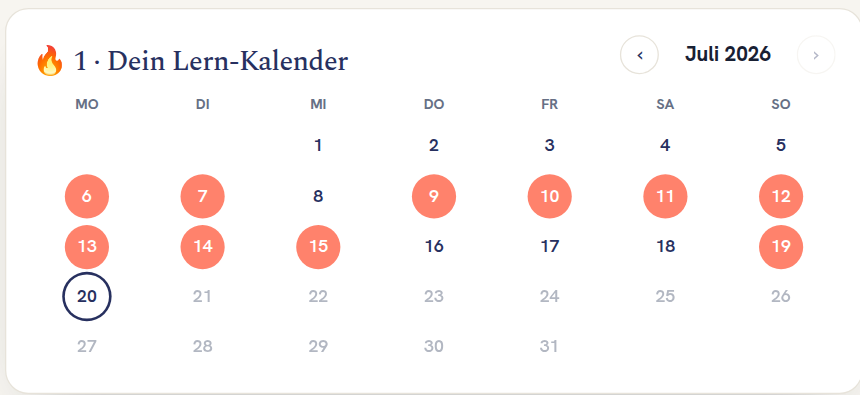
Progress shows up in what you can do, not in an unbroken chain of calendar days.
Coming Back Without Having to Explain Yourself
At Norimo, this leads to a simple principle: anyone coming back after a break, whether after three days or three months, doesn't have to justify anything or start over from scratch. There's no number that gets lost, no screen reminding you of what you missed before you can even keep learning, and no rush that gets in the way of low stimulus learning. The focus simply turns forward again: what do I already know, where do I pick up. Language learning is a long road with inevitably many interruptions: illnesses, moves, stressful weeks. An app that takes this seriously shouldn't punish these interruptions, but make coming back as easy as possible.
Ready to get started?
Learn languages with dialogues, audio, and review, at your own pace.