Learning a language without overwhelm: a calm approach for everyday life
Many people start learning a new language with genuine enthusiasm. They download an app, complete the first lessons, and feel proud of their first words. And then, often within just a few weeks, it stops. Not because the interest has disappeared, but because the learning itself has become a burden.
This is rarely a matter of missing discipline. It's often the design of the apps that are supposed to help. If a reminder stresses you out instead of motivating you, or a missed exercise triggers guilt that really has nothing to do with the language, it's worth asking whether the tool fits your learning style, not whether something is wrong with you.
Why traditional learning apps can feel overwhelming
Most major language learning apps rely on gamification: points, levels, virtual rewards. Basically a good idea, but in practice often overloaded and more stress than motivation. A streak, meaning a daily learning streak you don't want to break, creates exactly that fear of loss. Missing a day doesn't just cost you a number, it creates a feeling of having failed, even though objectively nothing was lost except the count itself.
Then there are timed exercises that turn a calm thinking task into a small stress test. Anyone who thinks more slowly under pressure or needs a moment to formulate an answer is systematically disadvantaged here, regardless of whether they actually know the answer. Pop-ups and push notifications interrupt everyday life with prompts to keep going right now. Leaderboards compare you to people whose learning situation, time, and prior knowledge are completely different. And because all of this runs at once, XP points, hearts, leagues, badges, daily goals, a jumble of game mechanics emerges that costs more cognitive energy than actually learning the language.
Why short, predictable sessions are easier to stick with
One reason many language learning resolutions don't stick is a lack of predictability. When every lesson has a different length, looks different, and ends differently, you have to decide anew each time whether you have the energy for it. That small decision, made several times a week, costs more energy over time than you'd think.
Short, consistent sessions get around this problem. If you know a lesson takes ten minutes, always follows a similar pattern, and is genuinely over afterward, you don't have to talk yourself into it every time. Predictability takes the weight off the task. That's exactly why fixed, small time windows in everyday life often work better than long, infrequent study sessions: ten minutes after breakfast, a quarter hour on the train, a short segment before bed. Not because shorter is automatically better, but because it's easier to repeat something small regularly than to push through something big occasionally.
Why progress pressure isn't motivating for everyone
Apps usually assume that visible progress automatically motivates: the more bars fill up, the more incentive there is. For some people, that's true. For many others, the effect reverses. A statistic showing you've learned less this week than last quickly becomes an accusation instead of an encouragement. A comparison with other learners says nothing about your own progress, but still feels like a judgment.
Especially with something as personal as a language, where pace, prior knowledge, and available time vary widely from person to person, outside pressure is often counterproductive. Learning out of fear of breaking a streak means learning out of avoidance, not out of interest in the language itself. And avoidance motivation rarely lasts long, because it doesn't build any real interest in the subject itself.
Concrete ways toward a calmer learning routine
A few simple principles help no matter which tool you learn with. First: choose a fixed, small time window instead of a vague daily goal. Not "I'll learn Spanish sometime today," but "I'll learn for ten minutes after I brush my teeth." Fixed triggers in everyday life turn an intention into a habit.
Second: allow repetition without grading. Looking at a word several times without it being immediately tested and scored is enormously relieving. Not every encounter with a word has to be a test, sometimes it's enough to simply see it again.
Third: use your own pace as the standard, not the app's or other learners'. If you need three passes through a lesson to remember it, you're not learning more slowly in a bad sense, you're learning more thoroughly.
Fourth: plan breaks without guilt. A week without learning doesn't interrupt any progress that can't be caught up on. The feeling of having "lost" something is usually an artifact of the app, not a linguistic reality. Once you internalize that, you can simply pick back up after a break without first needing to motivate yourself again.
Learning out of fear of breaking a streak means learning out of avoidance, not out of interest in the language itself.
How Norimo puts this approach into practice
It's exactly this observation that led us to build Norimo. The lessons are deliberately short and always structured the same way, so you know what to expect before you even start. There are no leaderboards, no comparisons with other learners, and no time limits that turn a thinking task into a stress test.
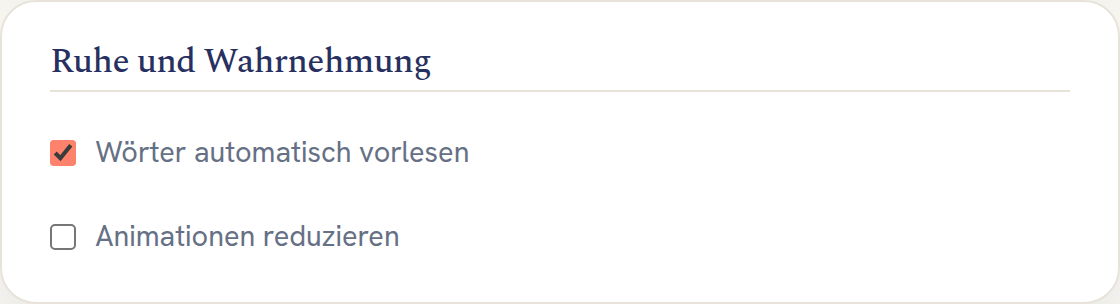
If you like, you can turn off notifications, visual effects, and streak displays entirely in the calm settings, choosing low-stimulation learning. What remains is the language itself: words, sentences, repetition, at your own pace. Progress is made visible, but not as a means of pressure, rather as a quiet confirmation of what you've already done.
It matters to us that a break in Norimo stays just that, a break, not a setback. You open the app again when it suits you and pick up right where you left off, with no lost numbers and no need to explain yourself. Learning a language is allowed to be calm. That's exactly what Norimo is made for.
Ready to get started?
Learn languages with dialogues, audio, and repetition, at your own pace.