Why situational language learning often comes more easily than memorizing single vocabulary words
People learning a new language rarely ask themselves: "What's the word for pillow, anyway?" Much more often, the question is: "What do I say if I'm standing at the hotel front desk and my room isn't ready yet?" This difference seems small, but it changes almost everything about how a language should actually be learned.
Isolated vocabulary lists have something reassuring about them. They're tidy, easy to test, seemingly complete. But they rarely answer the question that actually matters once we want to speak a foreign language for real. We want to be able to act in a specific moment, not just have a definition in our heads.
Words without an address
A single word like "complaint" or "directions" carries no information about when you'll actually need it. You learn it, file it away in memory, and it often sits there unused, like a tool with no clear purpose in a drawer. Only when a real situation comes up, say, at the doctor's office, when you need to explain exactly where it hurts, do you realize that the word alone isn't enough. You need the whole sentence, the right order, the right tone. "I've had pain in my lower back for three days" is something different from isolated knowledge of the words "pain," "back," and "since." It's exactly this gap between word knowledge and the ability to speak that trips up many learners, even ones with a large vocabulary.
Why context sticks in memory
Memory doesn't work like an alphabetical filing system, it works like a network of connections. The more anchor points a new piece of language has, to images, feelings, sequences of events, a recognizable scene, the more likely it is to stick. A situation supplies exactly that on its own. If you imagine standing next to a stranger at a party because you don't know anyone there, and after a brief silence you ask: "So, how do you know the host?", you're not just learning a question, you're learning a whole little scene: the uncertainty, the moment, the possible connection for the conversation afterward. This scene works like a mnemonic you don't have to invent yourself, because everyday life already provides it. With pure vocabulary learning, this anchor is almost entirely missing, which is why so much of it disappears again after a short time.
Sentences for when it counts
The benefit becomes especially clear when you think of typical situations that almost every language learner actually experiences at some point. Placing an order at a restaurant and wanting to leave out one ingredient. Checking in at a hotel front desk and asking for a later checkout. Asking for directions to the train station and actually understanding the answer, not just being able to ask the question. Chatting with coworkers about the weekend during a coffee break without it sounding stiff. In each of these cases, knowing individual nouns isn't enough. You need phrasing you can recall almost automatically, because the moment itself often leaves little time to think. That's exactly why most people I talk to about their learning journey don't actually want "more words," they want an answer to the question: What do I say when that exact thing happens?
We want to be able to act in a specific moment, not just have a definition in our heads.
Whole situations instead of single words
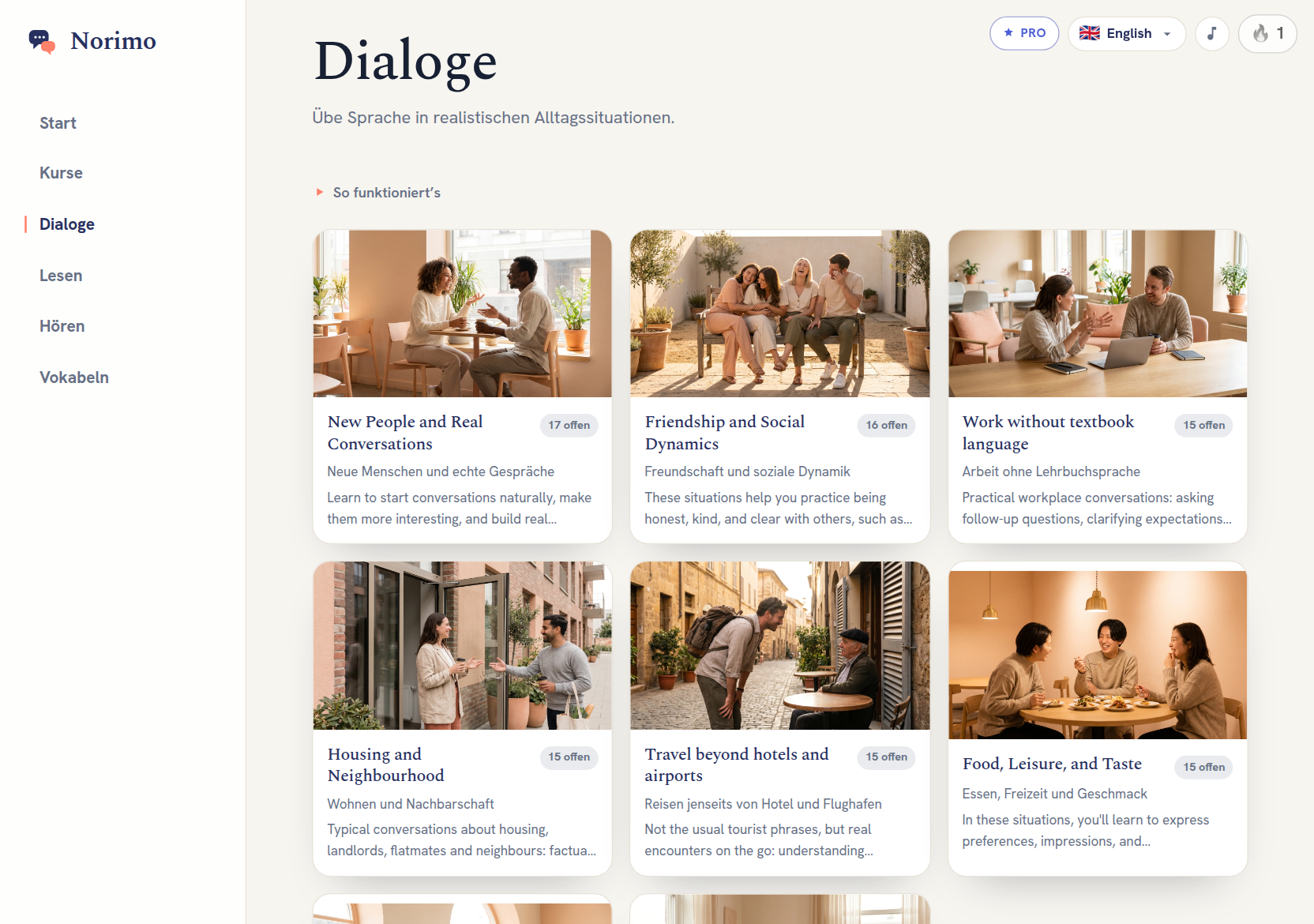
This idea is at the core of Norimo's dialogue situations. Instead of offering vocabulary lists that you memorize and then have to piece together yourself, we put concrete scenes at the center: arriving at a hotel, talking with a doctor, making small talk at a party. When you work through a situation like this, you don't just listen, you have to form your own sentences and find the right response, because only active speaking truly anchors a language in memory. Listening alone isn't enough for that. In the end, it's not about having collected as many words as possible, it's about having the right sentence ready the moment you actually need it.
Ready to jump right in?
Learn languages with dialogues, audio, and repetition, at your own pace.